

Your historical bullshit guide to Belgian Beer World
 Last time, I wrote about my first impressions of Belgian Beer World. This costly tourist attraction opened in 2023 right in the heart of Brussels, capital of beer country Belgium. It cost 90 million euros to renovate the old stock exchange building and set up the exhibit on the nation’s most popular drink. Most of this money was coughed up by the government, as the Belgian brewers themselves only contributed less than 6 million.[1]
Let’s just see how well this money was spent. After all, Belgian beer culture is on Unesco’s protected Cultural Heritage list, Belgium is home to the world’s biggest brewery, AB InBev. Belgium is rightly known for the great variety and quality of its beers, including a few respectable types that have been around for centuries, such as white beer, gueuze-lambic and Flemish old brown, and newer beers that found their way into drinkers’ hearts such as abbey beer, saison, Belgian strong pale ale, fruit beer and spéciale belge.
This should be a no-brainer, right? All this should logically result in a high-end top-quality visitor ‘experience’, not in the least because so much old and new material is available, and because so much wonderful history has been recorded, so many fantastic stories to tell? As might be expect from the united Belgian Brewers, who have a reputation to uphold? How difficult can it be to brew something worthwile out of that?
Well, apparently, this was too much to ask. The resulting Belgian Beer World is a hollow piece of fluff. And yes, I know it is meant to be an ‘experience center’, not a serious museum. The makers have clearly been looking at similar venues such as the Heineken Experience in Amsterdam, the Guinness Storehouse in Dublin, and similar brand theme parks like the ones by Coca-Cola, Mercedes and the many ‘chocolate museums’ around the world. So yes, I understand that it all has to be light as a feather, and that it has to consists of designer-concocted videos, games and Instagram moments.
Here however, as is usual with beer, a substantial amount of space has been alotted to a quasi-historical exhibit. After all, beer has been around for a considerably longer time than cola or cars, that’s one of its attractions. But it is precisely in this domain that they pissed it up the wall. To put it differently: Belgian Beer World is the biggest collection of historical ‘fake news’ I’ve ever seen put together. They have piled up the worst, dumbest clichés they could find, and then covered these turds with a shiny layer of fake gold.
It is all very tiresome, because in the end it’s up to historians to explain what is wrong about falsehoods like these, for the umpteenth time. So I guess this time I’ll have to to the job. Fasten your seatbelts, we’ll do a quick tour of what Belgian Beer World has to say about Belgian beer history. And afterwards, you can decide for yourself if you still need to go there.
Medieval water was undrinkable
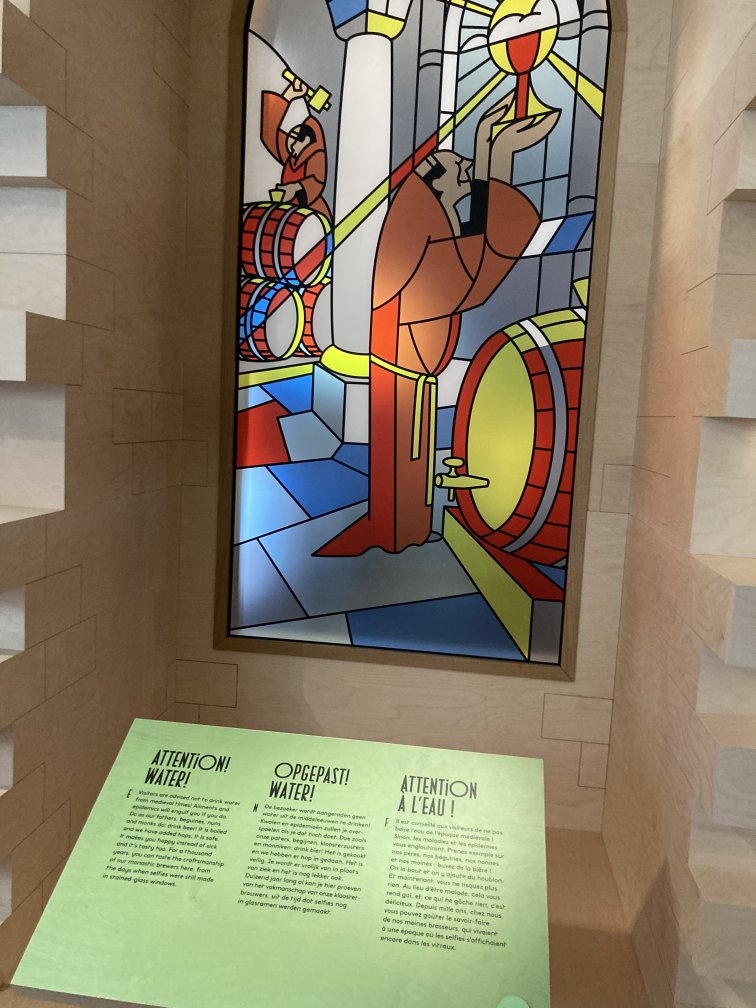 Right at the start of the exhibit, things go wrong. ‘Visitors are advised not to drink water from medieval times!’ a sign says. ‘Ailments and epidemics will engulf you if you do!’
Which is nonsense. Many authors have already pointed out that medieval people drank water all the time.[2] There was plenty of clean water available, how could it have been polluted in a sparsely populated, pre-industrial Europe? It didn’t kill the animals either, or did they drink beer too? And then I’m not even talking about the many bylaws issued by city councils, in order to prevent any pollution that might occur. And rightly so: to brew beer, you needed clean water. Of course, Medieval people drank much more beer that we do. But that’s because people like to drink something with a flavour. Coffee, tea, lemonade, soft drinks and Red Bull didn’t exist, fruit juice and milk were perishable. So people drank beer for its taste, not because there was something wrong with water.
Duke John was Gambrinus
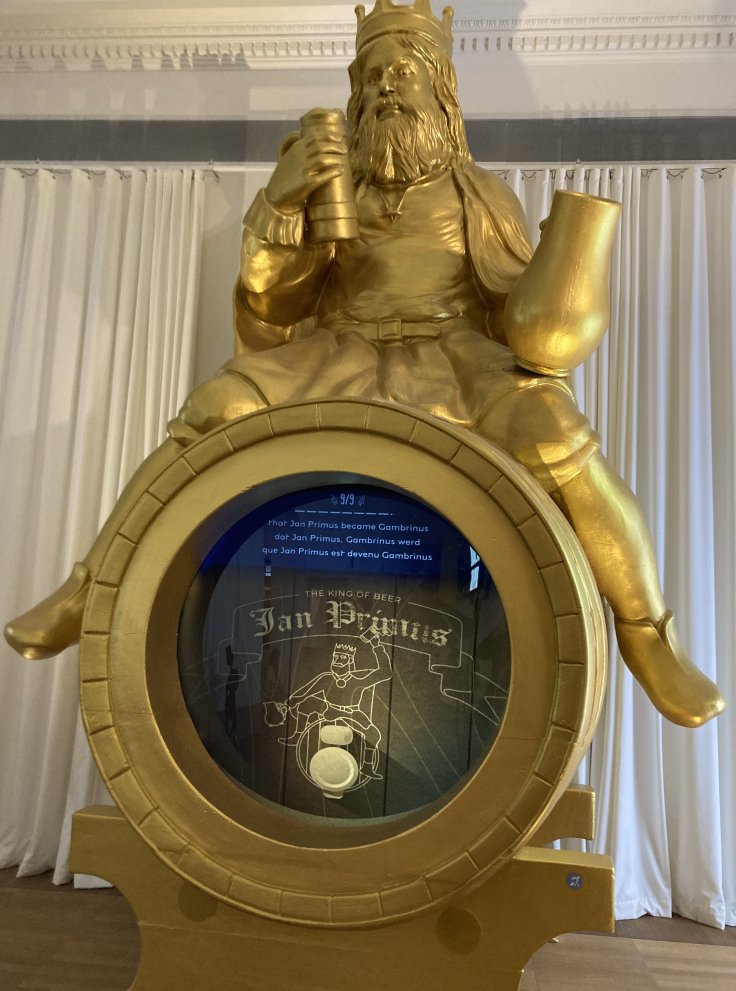 A funny coincidence: the 1873 stock exchange building stands on the exact location of the Franciscan monastery where once John I of Brabant (ca. 1253-1294) lay buried. In the building’s basement this is reflected by a display of archeological finds among other things, including a possible fragment of the duke’s tomb. But what do we read once we get to the upper floors? ‘Duke John I of Brabant! Jan Primus, king of beer. The man who thanked his soldiers on the battlefield with a beer feast, after the battle of Worringen. The army chief who addressed his troops from a beer barrel, known around the world as Gambrinus.’
No, no, no… no! No, Duke John was not known as Jan Primus, at least not until a German amateur historian invented this name out of thin air in 1858. And no, we don’t even know whether Duke John drank beer at all, if he ever treated his soldiers to beer, and he certainly didn’t address them from a beer barrel. The name of mythical beer king Gambrinus (a name that will mean absolutely nothing to 99% of the visitors anyway) is derived from a fictitious German king, dreamt up in 1498 by an Italian monk.
All this has been debunked several times ad nauseam, and yet this entirely bogus ‘Jan Primus’ connection keeps surfacing.[3] The dimwits at Belgian Beer World have dedicated a 5 metre high fake golden statue with tv screen to it. It is all very, very tiresome.
Saint Benedict grants permission
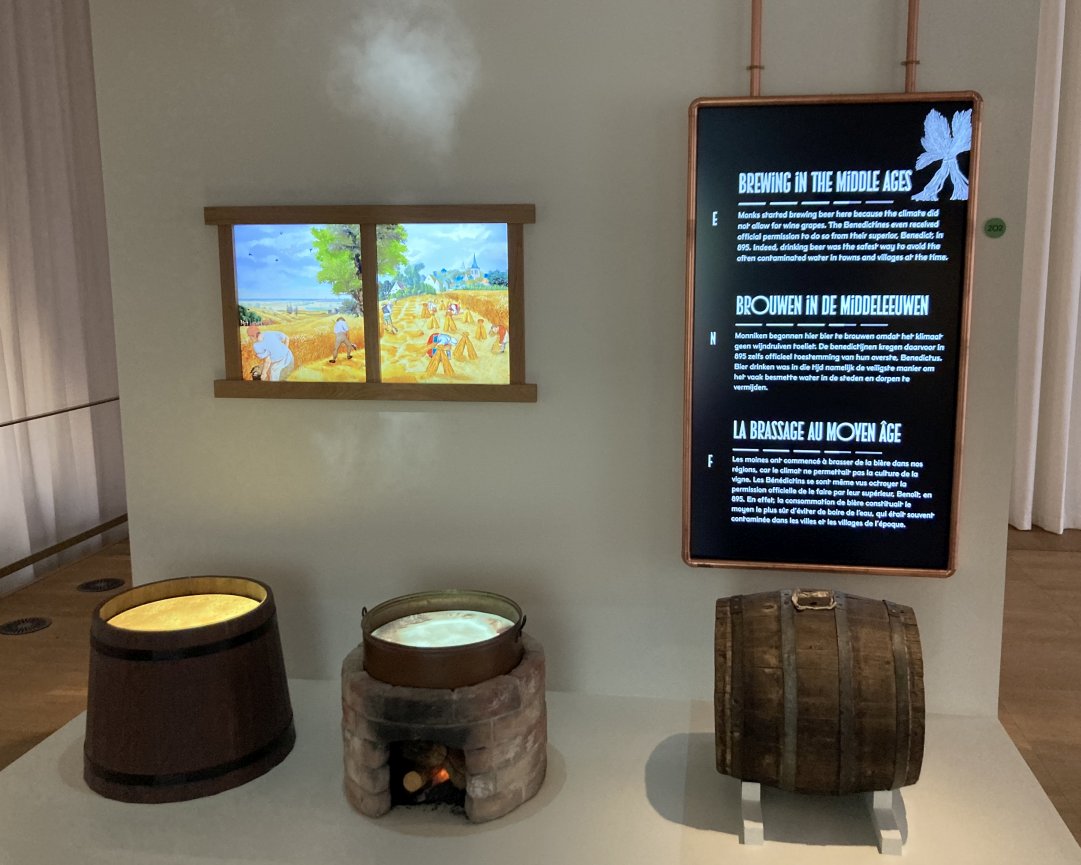 ‘Monks started brewing beer here because the climate did not allow for wine grapes. The Benedictines even received offical permission to do so from their superior, Benedict, in 895.’ Which is remarkable, because Saint Benedict of Nursia died in 547, and in 895 he had been dead for over three centuries. Where did they get this year 895 from in the first place? For one thing, I have never come across it begore. The nearest thing I could find, is that in 895 the Council of Tribur (Germany) reiterated a rule formulated at Worms in 868 that certain penitents had to abstain from wine, mead and honeyed beer three times a week.[4] Or to put it differently: this is bogus too.
Brewsters were the first witches
‘For a long time, brewing beer was a kitchen job for women. The brewsters would stick a broom through the window to show that fresh beer was on sale.’ So far, so good. ‘They kept cats to keep mice out of the grain, wore hats to be recognised and had a large couldron in which they mixed herbs.’ The suggestion is clear: ‘During the witch hunts a few centuries later, witches were often depcited with those recognisable marks of brewsters.’ But the crux is in this ‘a few centuries later’: by the time Europe started hunting witches, brewing had become largely a men’s profession.
Historian Judith M. Bennett has written a sizeable volume on ‘alewives’ in England, and in her book the concept of ‘witch’ is hardly mentioned at all, except for a few derogatory descriptions of brewing women after the year 1500, so when the early-modern witch hunts were already in full swing.[5] In the Netherlands, Marjolein van Dekken has written about female brewers, and her book doesn’t even mention the word ‘witch’.[6]
To recap: the connection alewife – witch is patent nonsense, but Belgian Beer World turns it into an Instagram moment, with witch hat, broom and lantern.
Gruit
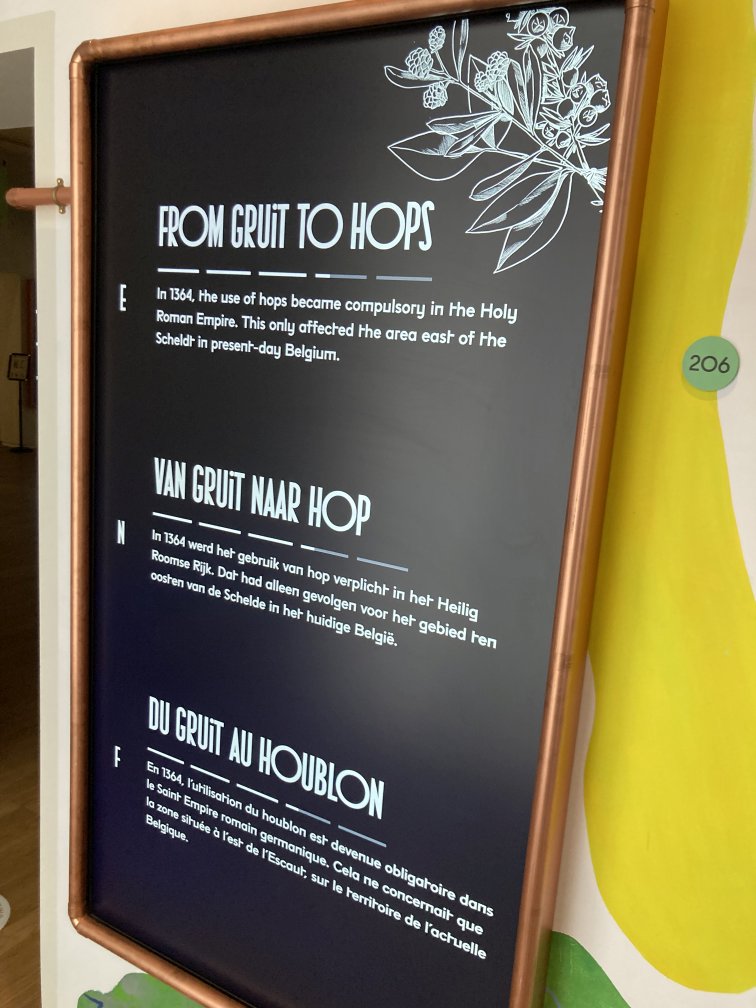 Have you got a moment? In Belgian Beer World, the transition from brewing with a herb mix called gruit to brewing with hops, which took place during the 14th and 15th centuries, is inevitably a source of misunderstandings, semi-truths and outright hogwash.
We read that in cities, the city governments controlled beer production by ‘levying taxes and excise duties. Many towns levied excise duties on the gruit.’ No, you dummies, the gruit WAS the tax: it was a government monopoly, they sold it at artificially high prices. Excise is something you levy on things sold by other parties to eachother, for instance on beer sold by a brewer to a customer.
And then there’s another classic: ‘In 1364, Charles IV, the emperor of the Holy Roman Empire, mandated the use of hops (…) This only affected the area east of the Scheldt. In Flanders (because of taxes), people continued to brew mainly with gruit for several centuries.’
No, no, no… no! I’ve dealt with this entirely baseless junk before, when I came across it in The Belgian Beer Book (2016). I lambasted mr. Verdonck and mr. De Raedemaeker for it, put the tale is older.[7] It is astonishing that it surfaces again here, I’ve rarely come across bigger nonsense.
To summarise: in 1364 emperor Charles IV mandated absolutely nothing, he merely described a development that was already going on. Also, it concerns a text about the Prince-Bishopric of Utrecht, today in the Netherlands, where people continued to use gruit on a small scale all the way into the 15th century, so again: there was no legal obligation at all.
Another fantastic sample of their incompetence: ‘Regional diversity: different grains produce a different malt or beer. Moreover, almost every town had its own town beer, as the town authorities controlled the composition of the gruit to levy taxes on it.’ A fascinating tangle of sense and nonsense. Regional beers only emerged after gruit disappeared, simply because the introduction of hops made it possible to export beers, and therefore to compare them. Indeed, towns have often issues bylaws on the composition of beer, but they always concerned the quantity and proportion of the grains used, they never concerned hops or gruit.
Dutch taxes in 1822
And I could go on. For now, I’ll just look at a sign that is part of a timeline: ‘Brewers oppose Dutch taxes, 1822’. Instinctively, you feel what is suggested: at that time, Belgium and the Netherlands were one country, and of course those naughty Dutchies wanted to introduce those mean beer taxes. Shame on them!
But guess what, the joint Dutch beer law already dated back to 1816, in 1822 they only renewed it. I’ve never come acros resistance to it. Quite the contrary: in 1829 it was proposed to change the beer law, but the brewers of Lier (in Belgium) sent a request to parliament, indicating that they wished for the law to stay the same![8]
 Perhaps you can imagine how discouraging this is. A 90 million beer museum, and they come up with this bunch of screaming nonsense. By the way, who are responsible for this shamefully meagre pile of ‘fake news’? The exhibit was developed by Bureau Bruns from Bergeijk (NL), screen crafter Create.eu from Evergem (near Ghent) and interior builder Potteau from Heule (near Kortrijk).[9] Just so you know.
In any case, this Belgian Beer World is an odd institute: because so many different brewers are contributing, everything has to remain as neutral as possible. It would be a no-no to push Duvel harder than Leffe, or Tongerlo harder than Brugse Zot. Only the rooftop terrace has its merits: there is a bar with a wide selection of Belgian beers, and you can behold the skyline of Brussels, with its modern office buildings alternated with crumbling chimneys.
Then again, you can also get a view of this skyline from the Atomium or the Palace of Justice, and there’s no shortage of great beer at street level. Perhaps not unsurprisingly, Belgian Beer World is not doing well. Originally, they expected to have 400,000 visitors a year, in reality it’s only 100,000. Again, the government is to contribute funds, to save an attraction which mainly glorifies the products of wealthy brewing giants.[10] By promoting historical ‘fake news’.
I’ve mailed the management, pointing out the many falsehoods, but I would be suprised if they’re going to give it any priority. A new director, Dirk Lubbers, formerly in charge of the Heineken Experience in Amsterdam, has been flown in to get the place back on track, and I understand that he has bigger fish to fry. The beer theme park is in dire straits. But you know what? Maybe they’ve asked for it, by telling people so much utter nonsense.
[1] https://www.knack.be/nieuws/cultuur/hoe-sven-gatz-met-belastinggeld-zijn-brusselse-biertempel-bouwde/
[2] Leendert Alberts, Hop. De eerste bierrevolutie in Nederland, Amsterdam 2022, p. 23-24, 225. Cf. https://zythophile.wordpress.com/2014/03/04/was-water-really-regarded-as-dangerous-to-drink-in-the-middle-ages/
[3] Cf. Jan Grauls, ‘De legende van koning Gambrinus’, in: Terug naar de oorsprong, Hasselt 1966; Wolfgang Stammler, Kleine schriften zur Literaturgeschichte des Mittelalters, p. 120-124.
[4] Christian Berger, ‘The three breweries of St Gall Abbey and the beer in Carolingian times’, 2021, downloadable on: https://beer-studies.com/en/Advanced-studies/carolingian_brewing
[5] Judith M. Bennett, Ale, beer and brewsters in England. Womens Work in a Changing World, 1300-1600, New York 1996.
[6] Marjolein van Dekken, Brouwen branden en bedienen. Werkende vrouwen in de Nederlandse dranknijverheid, 1500-1800, Amsterdam 2010.
[7] https://lostbeers.com/fact-check-the-belgian-beer-book/
[8] A. Hallema en J.A. Emmens, Het bier en zijn brouwers. De geschiedenis van onze oudste volksdrank, Amsterdam 1986, p. 176.
[9] https://www.bruns.nl/project/belgian-beer-world; https://www.create.eu/cases/belgian-beer-world; https://potteau.be/nl/musea_fiche.php?id=1095.
[10] https://www.bruzz.be/actua/cultuurnieuws/directeur-dirk-lubbers-over-sputterend-beer-world-meteen-winst-niet-realistisch; https://www.vrt.be/vrtnws/nl/2025/04/23/uitbater-beursgebouw-vraagt-lening-aan-om-werkingskosten-te-dekk/
Share this post:


Posted in Blog - Tags: abbey beer, Belgium, Brussels, Duke John of Brabant, Fact check, Gambrinus, gruit, museum, water
Thanks for your analysis. It is even worse than what I noticed…