


Aarschot: no finer beer than a Brown one
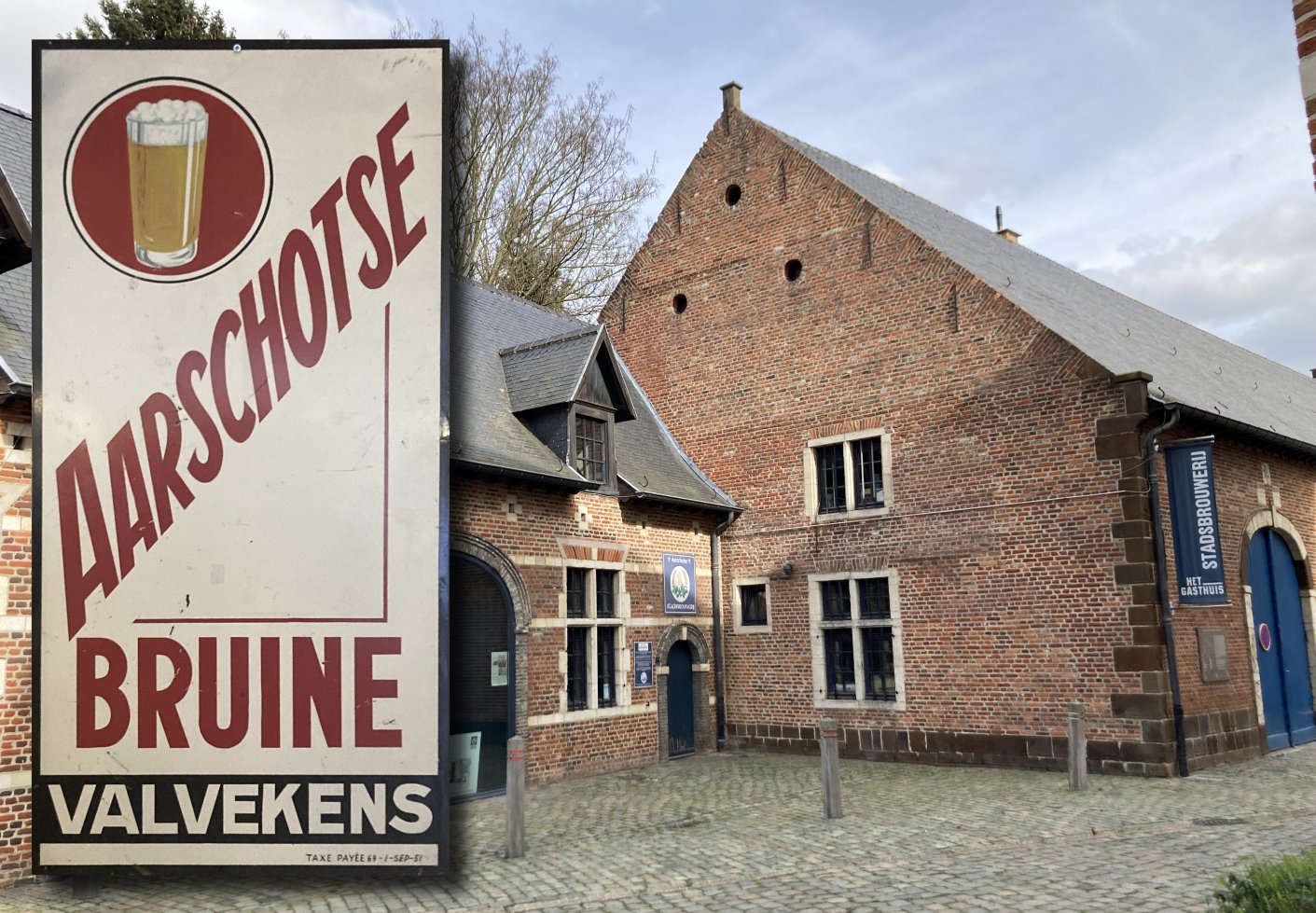 What can be more fun than just driving around Belgium and see wat you bump into? That’s the way I ended up in Aarschot, a town of about 16.000 inhabitants on the river Demer, in the east of the Flemish Brabant province. A historical town, with a large church and a beguinage, though unfortunately the two world wars have left a trail of destruction. Another thing that has affected local built heritage is neglect, if the way the historical Duke’s watermills were left to fall into ruin is anything to go by. Only in 2010 have these been renovated and modernised. In any case, I wouldn’t be writing about this if Aarschot didn’t have its own beer: the ‘Aarschotse Bruine’, or Aarschot Brown.
‘And father drank a brown one, ha ha, there is no finer beer than brown, ha ha…’ A song which expressed the feeling that the people of Aarschot had about its local beer, hundred years ago.[1] The years 1880-1940 must have been the heyday of various local and regional beers, especially in (Flemish) Brabant and Eastern Flanders. Sweet beers like Diesters (from Diest), Zoeg (from Tienen) or beers of a more sweet-sour nature such as Oud-Zottegems, Duivelsbier (‘Devil’s beer’ from Halle) and Jack-Op (a brand from Werchter).[2] Beers that have largely disappeared today: the breweries that once made them were small and old-fashioned, and the taste of drinkers changed.[3]
And then, there was Aarschot Brown. Allegedly it was devised by Henri Tielemans, who married a brewer’s daughter in 1857 and ran his wife’s family’s brewery from then on. Other well-known Aarschot breweries were Valvekens, which started business around 1904, and steam brewery Het Drossaarde, which closed shop just before the First World War.[4]
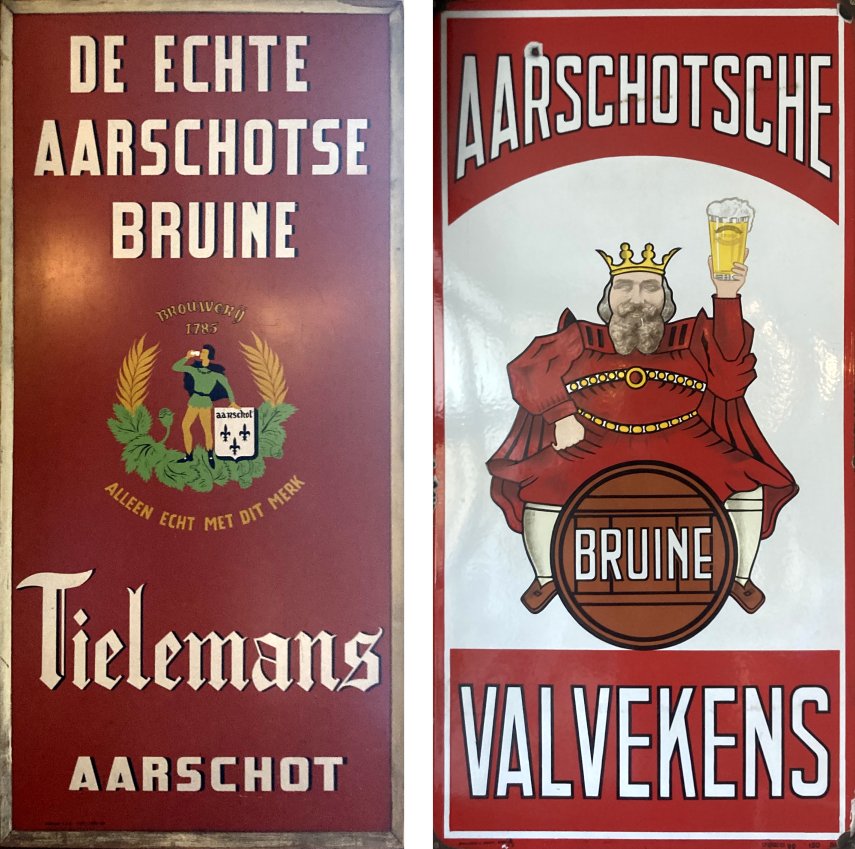 Aarschot Brown was a household name in the Demer valley, as well in places where those of Aarschot went to work in coal mines, such as Beringen in Belgian Limburg or Marcinelle near Charleroi. It was known for its sour taste, which resulted from ageing it for six to nine months in barrels, and then blending it with fresh beer. Some drinkers would add a lump of sugar because of its sourness.[5] The breweries of Aarschot produced it, as did those of the nearby village of Betekom, as well as Jack-Op in Werchter and the brewery of Veltem near Leuven.
Around 1970 the fun was over: the last two breweries of Aarschot closed down, and the real Aarschot Brown disappeared. In 1979 Wilfried Patroons described how it used to be made: with 30% aromatic malt, 20% wheat and a small amount of aged hops. ‘For fermentation, barrels of 230 litres were used, called “poensels”. The beer was then blended with older brews, which enabled some variation in taste.’[6]
And yet, today Aarschot Brown is available again. In 2012 a small group of amateur brewers joined forces with the city council to revive the beer. As a brewing location, they chose a small building on the grounds of the former monastery of the Sisters of St. Francis, where up to 1917 the nuns would brew beer for patients in their hospital, and for themselves. Great enthusiasm all around: an elaborate display of beer glasses and other paraphernalia was installed in the adjacent town museum, and the beer was served in its ‘Brown Café’. As a cultural-touristic project, and officially a part of the town council’s organisation (it rightly called itself a ‘town brewery’), they could brew about 10,000 litres of beer yearly.
Brewer Tony Bries told PINT Magazine in 2014 how the Brown is produced: first, they brew a conventional brown beer with pilsener, pale ale, munich, chocolate and wheat malt, with some oak chips for a woody touch. Then, in a mixing vessel a mix of lactic acid, acetic acid and phosphorous acid is added. The historical ABV of about 4% was raised to 6%.[7]
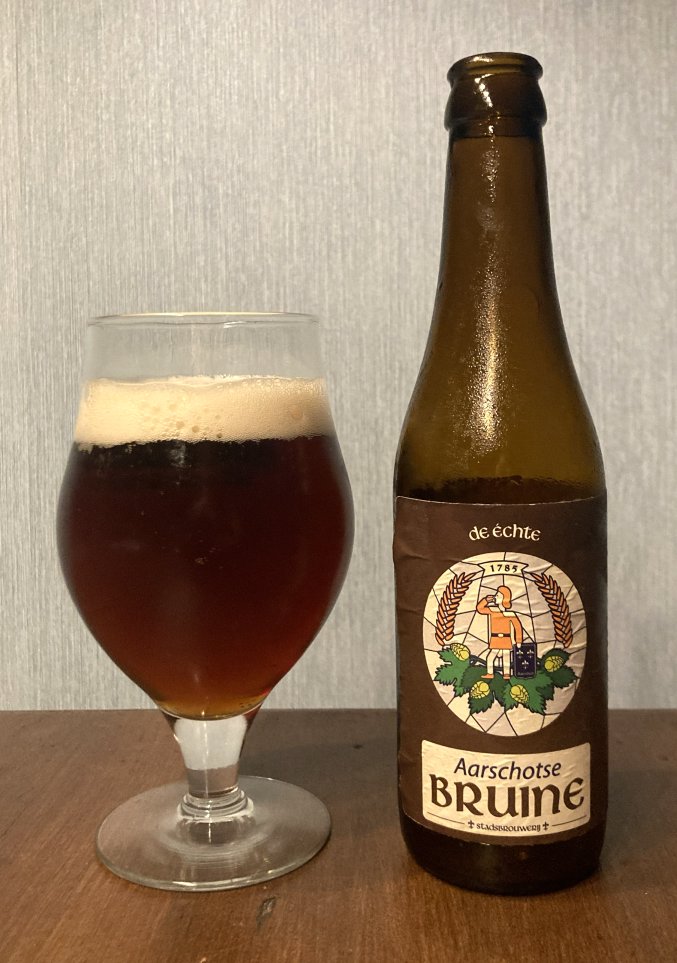 Surely I wanted to have a taste of that. Upon entering the museum, I noticed that the display of glasses has now disappeared. As it turns out, the winds have changed politically, and apparently, being proud of a well-made alcoholic product is less fashionable today. Luckily, the brewery and the café are still there, so I was able to follow the well-tested practice of making a ‘copy of the shop’: to buy one of each item on sale.
So what does this historical beer taste like? To be honest, I found their Aarschotse Bruine to be rather sweetish and cloying. Its light acidity is hard to identify, it tastes more of caramel. On the other hand, they also produce an Oud bruin, and that one is fantastic: a beautiful sourness with a sweet touch, as far as I’m concerned it measures up to venerable beers like Duchesse de Bourgogne by Verhaeghe. The same is true for the Aarschotse Bruine Grand Cru: a very well-made beer in the best tradition of Flemish old brown.
In short, beer tradition is very much alive in Aarschot, as long as the city council just keeps the brewery afloat, this little town remains certainly worth the detour for beer lovers.[8]
[1] André Delsaerdt et al., Het vorig leven van de Aarschotse bruine, Aarschot 2012.
[2] Cf. Wilfried Patroons, Bier, Antwerpen 1979, p. 36-37.
[3] In a way, Diesters lives on in the form of Gildenbier made by Haacht, while the Boon brewery has recently given a new boost to its Duivelsbier production.
[4] Delsaerdt, Het vorig leven van de Aarschotse bruine.
[5] Het Laatste Nieuws 26-4-2025.
[6] Patroons, Bier, p. 37.
[7] Peter Kuppers, ‘Aarschotse Bruine. Reïncarnatie van een streekbier’, in: PINT Magazine 203 (August 2014), p. 26-28.
[8] https://hetgasthuis.be/stadsbrouwerij


Leave a Reply